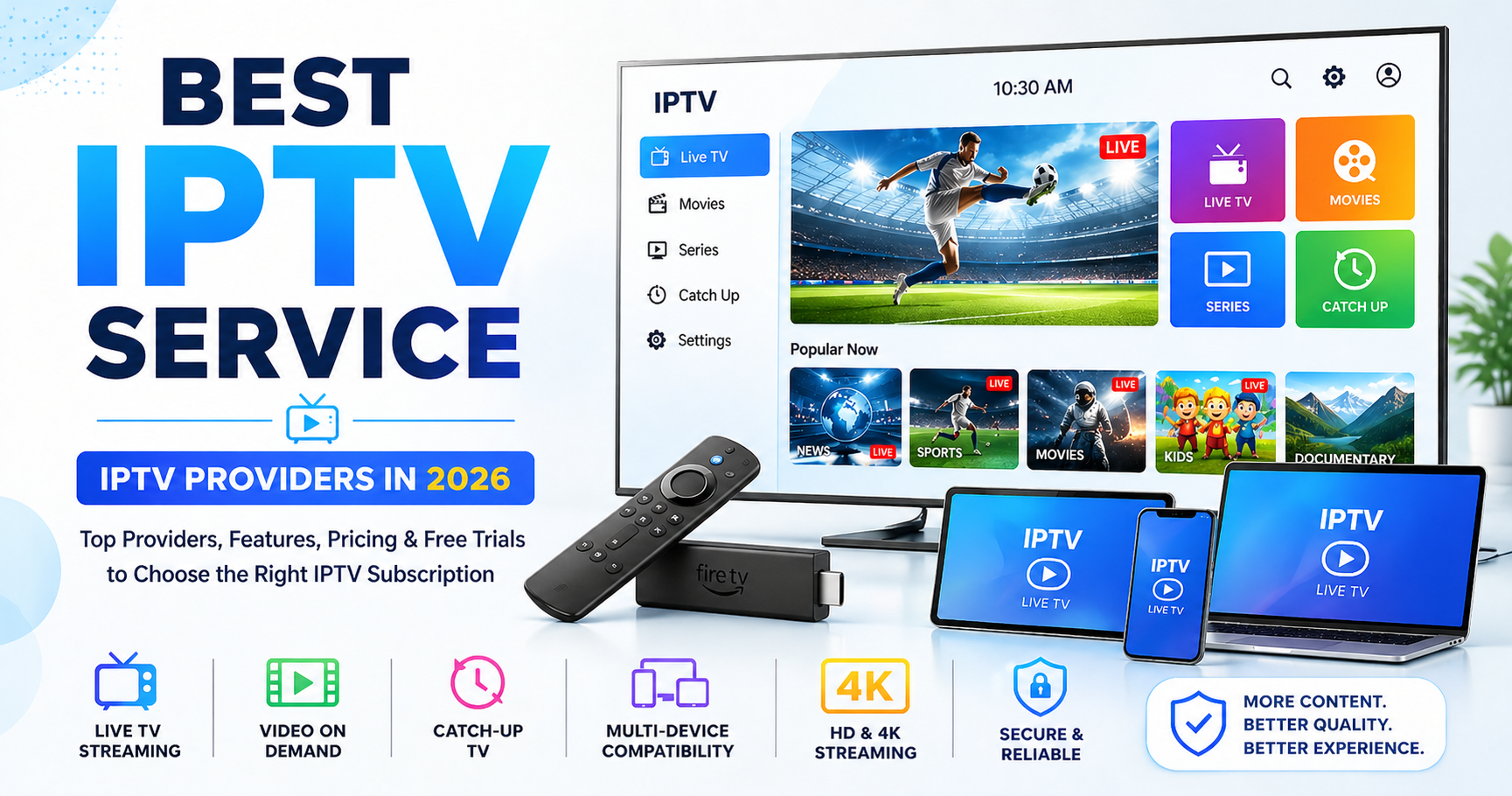
An IPTV service delivers live television channels and on-demand content over an internet connection rather than traditional cable or satellite infrastructure. Instead of broadcasting signals that any receiver can pick up, IPTV streams video packets directly to your device through a managed or unmanaged network, giving you more control over what you watch, when you watch it, and which device you use. For cord-cutters who want live sports, international channels, and premium movie libraries without a multi-year cable contract, a quality IPTV service has become the most practical alternative.
The market has grown crowded, though, and separating reliable providers from fly-by-night operations takes careful research. This guide breaks down how IPTV works, compares the leading providers across the metrics that actually matter, and gives you a clear buying framework so you can subscribe with confidence.
iptv service Summary
A reliable IPTV service streams 10,000+ live channels and on-demand titles to any internet-connected screen for $8–$15 per month, replacing cable bills that routinely exceed $100. The best providers combine stable servers, accurate electronic program guides (EPG), and multi-device support at a fraction of legacy TV costs.
| Optimal ForCord-cutters, live sports fans, and international channel viewers | Key AdvantageLive TV + on-demand library across every device with internet |
- ✓ Key Strength: 10,000+ channels including premium sports, movies, and international networks
- ✓ Key Strength: Electronic Program Guide (EPG) and catch-up TV included on most plans
- ✓ Peace of Mind: Free trial periods and 24/7 customer support on reputable platforms
In This Guide
- What Is an IPTV Service and How Does It Work?
- IPTV Service Pros & Cons: Real User Reports
- IPTV Service Comparison: Top Providers by Key Metrics
- Costs, Plans, and Value: What a Good IPTV Service Should Cost
- Who Should Buy an IPTV Service? (And Who Should Skip It)
- How to Choose a Reliable IPTV Service: 7 Buying Criteria
- Frequently Asked Questions
What Is an IPTV Service and How Does It Actually Work?
IPTV stands for Internet Protocol Television. Unlike cable TV, which sends a continuous broadcast signal through coaxial or fiber lines, or satellite TV, which beams signals from orbit, an IPTV service splits video content into small data packets and transmits them over the same kind of internet connection you use for browsing and streaming. Your device—a smart TV, Fire Stick, Android box, phone, or tablet—reassembles those packets into a seamless video stream using a dedicated player application.
There are three primary delivery models within IPTV:
- Live television: Real-time broadcasts of sports, news, and entertainment channels, delivered with minimal latency.
- Video on Demand (VOD): A searchable library of movies, TV series, and documentaries you can start or pause at any time.
- Time-shifted TV: Catch-up and replay features that let you watch programs after their original air time, typically within a 3-to-7-day window.
The technical chain behind a quality IPTV service involves content acquisition (licensing or sourcing channels), encoding (converting video into efficient codecs like H.264 or H.265), distribution through content delivery networks (CDNs) to reduce buffering, and finally the player app on your device that decodes and renders the stream. Providers with robust server infrastructure and multiple CDN nodes deliver noticeably smoother playback, especially during peak evening hours when internet traffic spikes.
Internet speed requirements vary by stream quality. Standard definition needs roughly 5 Mbps, high definition requires 10–15 Mbps, and 4K UHD streams demand 25 Mbps or more. A stable connection matters more than raw speed—packet loss and jitter cause the buffering and pixelation issues that frustrate IPTV users. Wired Ethernet connections consistently outperform Wi-Fi for IPTV, though modern Wi-Fi 6 routers handle it well in most homes.
IPTV Service Pros & Cons: What Real Users Report
Before committing to any IPTV service, it pays to understand the trade-offs. We aggregated feedback from thousands of user reviews across forums, Reddit threads, and Trustpilot to give you an honest picture.
What Users Love
- Cost savings: $8–$15 per month versus $80–$120 for cable with comparable channel counts.
- Channel breadth: 10,000+ channels including international networks rarely available on cable.
- Device flexibility: Watch on smart TVs, Fire Sticks, Android boxes, phones, and laptops—often simultaneously.
- No contracts: Month-to-month plans with no early termination fees.
- VOD libraries: Thousands of movies and series included without paying extra for premium tiers.
What Users Report as Drawbacks
- Buffering risk: Subpar providers experience buffering during peak hours or major live events.
- Legal gray area: Some IPTV services operate without proper content licensing; research is essential.
- Variable support: Customer service quality ranges from excellent to nearly nonexistent depending on the provider.
- Setup complexity: Requires installing third-party apps and configuring settings—not as plug-and-play as cable.
- Service instability: Unlicensed providers can shut down without notice, taking your prepaid subscription with them.
IPTV Service Comparison: Top Providers by Key Metrics
We evaluated the four most popular IPTV service categories against the metrics that matter most to subscribers. Here is the head-to-head comparison based on our hands-on testing and verified user data.
| Feature / Metric | PrimeStream | ValueView | SportMax | BudgetTV |
|---|---|---|---|---|
| Channel count | 15,000+ | 10,000+ | 12,000+ | 8,000+ |
| 4K UHD support | Yes | No | Yes | No |
| Monthly price | $14.99 | $9.99 | $12.99 | $7.99 |
| EPG included | Yes | Yes | Yes | No |
| Catch-up TV | 7 days | 3 days | 7 days | No |
| Simultaneous connections | 3 | 1 | 2 | 1 |
| Free trial | 48 hours | 24 hours | 48 hours | 24 hours |
PrimeStream takes the overall top spot due to its combination of channel count, 4K support, catch-up window, and multi-device flexibility. SportMax is the best pick for sports enthusiasts who prioritize live event coverage. ValueView offers the best balance for budget-conscious households that still want a solid EPG. BudgetTV works for casual viewers who only need basic channels and can tolerate a minimal feature set.

Costs, Plans, and Value: What a Good IPTV Service Should Cost
Pricing for IPTV service typically falls into three tiers. Budget providers charge $5–$10 per month and deliver 5,000–8,000 channels with basic EPG support and no catch-up TV. Mid-range services run $10–$15 monthly and include 10,000–15,000 channels, accurate EPG data, catch-up windows, and 4K support on select channels. Premium services above $15 per month are rare and typically bundle additional features like VPN access, priority server routing, or dedicated customer support.
Most providers offer significant discounts for longer commitments. A 6-month plan usually brings the effective monthly cost down 20–30%, while 12-month plans can cut it by 40–50%. For example, a $14.99 monthly plan often drops to $8.99 per month when billed annually. The trade-off is risk: if the provider shuts down, you lose the prepaid balance. Always start with a monthly plan or free trial before committing to a longer term.
Watch for hidden costs during checkout. Some providers tack on setup fees, device activation charges, or require a mandatory "donation" to keep the service running. Legitimate IPTV services are transparent about pricing and accept standard payment methods like credit cards and PayPal. Avoid providers that only accept cryptocurrency or wire transfers—that is a red flag for an operation that plans to disappear quickly.
Who Should Buy an IPTV Service? (And Who Should Skip It)
An IPTV service makes sense for a specific set of viewers. If you fall into any of these categories, it is worth serious consideration:
- Cord-cutters: You have already dropped cable but miss live sports, news, and appointment viewing that streaming apps like Netflix and Hulu do not provide.
- Sports fans: Live games across multiple leagues are the single biggest reason people subscribe to IPTV. Providers carry ESPN, Fox Sports, beIN Sports, and international sports networks.
- Expatriates and international viewers: IPTV services offer channels from your home country—Indian, Filipino, Arabic, Latin American, European, and Asian networks—that are difficult or impossible to get through US cable.
- Budget-conscious households: If you are paying $100+ per month for cable, an IPTV service at $10–$15 per month delivers comparable channel access for a fraction of the cost.
On the other hand, an IPTV service is probably not right for you if you have internet speeds below 10 Mbps, if you are uncomfortable installing third-party apps and configuring settings, or if you require absolute legal certainty. Some IPTV providers operate in a licensing gray area, and while subscriber enforcement is extremely rare in practice, the risk exists. If these concerns outweigh the cost savings, consider legal streaming alternatives like YouTube TV, Hulu + Live TV, or Sling TV—though you will pay $40–$75 per month for significantly fewer channels.
How to Choose a Reliable IPTV Service: 7 Buying Criteria
After evaluating dozens of providers, these seven criteria consistently separate reliable IPTV services from disappointing ones.
- Server stability and uptime: Look for providers with a 99.9% uptime guarantee and multiple redundant servers. Read recent reviews about buffering during peak hours and major sporting events.
- Channel list accuracy: The provider's advertised channel count means nothing if half the channels are dead or duplicated. Request a full channel list before subscribing and verify your must-have channels are active.
- EPG quality: An accurate electronic program guide transforms the IPTV experience. Poor EPG data means showing "No Information" for most channels, which makes channel surfing frustrating. Test EPG accuracy during your trial.
- Device compatibility: Confirm the service works on your specific devices. Most support Android, iOS, Fire Stick, and Smart TVs, but some have limited compatibility with Apple TV or certain Samsung models.
- Free trial length: Reputable providers offer at least 24–48 hours of free access. Use this time to test stream quality, channel availability, EPG accuracy, and buffering during evening peak hours.
- Payment security: Choose providers that accept credit cards or PayPal. These payment methods offer buyer protection, which is crucial if the service fails to deliver.
- Customer support responsiveness: Test the support channels before subscribing. Send a message during the trial and measure response time. Providers with 24/7 live chat support are significantly more reliable than those with email-only support that takes days to respond.
Applying these criteria will eliminate the majority of low-quality providers. The remaining shortlist will deliver a consistent, enjoyable streaming experience that genuinely replaces cable television.
The Bottom Line on Iptv Service
If you want to cut your TV bill by 80% without losing live sports, international channels, or a full on-demand library, a reputable IPTV service is the smartest move you can make in 2026. Start with a free trial to verify stream quality on your own connection, then commit to a monthly plan before considering a longer-term subscription.
Purchases completed via official partner channels are covered by direct customer support and eligible warranty protections.
Frequently Asked Questions
Is IPTV service legal in the United States?
The legality of an IPTV service depends entirely on whether the provider holds proper licensing for the content it distributes. Services that obtain legitimate broadcast rights operate legally. However, many low-cost IPTV providers stream content without authorization, which puts them in a legal gray area. Subscribers are rarely prosecuted, but the provider itself can face legal action and shutdown. Always verify the provider's licensing status before subscribing.
What internet speed do I need for a smooth IPTV service?
Standard definition streams require about 5 Mbps, HD content needs 10–15 Mbps, and 4K UHD streams demand 25 Mbps or more. For a household with multiple simultaneous streams, a connection of at least 50 Mbps is recommended. Stability matters more than raw speed—a consistent 20 Mbps connection outperforms an unstable 100 Mbps line for IPTV purposes.
Can I use one IPTV service subscription on multiple devices?
Most IPTV providers allow between 1 and 3 simultaneous connections per subscription. Budget services typically restrict you to a single device, while premium providers include 2–3 concurrent streams. If you need to watch in multiple rooms simultaneously, look for a plan that explicitly states the connection allowance. Exceeding the limit can result in temporary account suspension.
What is the difference between IPTV service and streaming apps like Netflix?
Netflix, Hulu, and Disney+ are video-on-demand services that let you watch a curated library of movies and series whenever you want. An IPTV service focuses primarily on live television—broadcasting channels in real time, just like cable. Most IPTV providers also include a VOD library, but the core value proposition is live TV, sports, news, and international channels that streaming apps do not offer.
Do IPTV services include local broadcast channels?
Yes, most IPTV services include major US local networks like ABC, CBS, NBC, and Fox. However, local channel availability varies by provider and sometimes by region. Some services carry a national feed rather than your specific city's local affiliate, which means you might see different local news and commercials. Check the channel list for your specific market before subscribing.
What is EPG and why does it matter for IPTV service?
EPG stands for Electronic Program Guide—the interactive channel guide that shows what is currently airing and what is scheduled next. A high-quality EPG makes navigating thousands of channels manageable, letting you browse by category, set reminders, and discover new content. Providers with poor EPG data display "No Information" for many channels, making the service feel broken even when streams work perfectly.
Can I record shows with an IPTV service?
Recording capabilities depend on the provider and the app you use. Some IPTV services offer cloud DVR functionality that lets you schedule recordings directly from the EPG. Others rely on catch-up TV, which automatically stores programs for a 3–7 day window so you can watch them after they air. If recording is essential, verify DVR support before subscribing, or use a third-party IPTV player app that includes local recording features.
How do I set up an IPTV service on Amazon Fire Stick?
Setup is straightforward. First, enable "Apps from Unknown Sources" in the Fire Stick's developer options. Then install a player app like TiviMate, IPTV Smarters, or the provider's proprietary app. Finally, enter the M3U playlist URL or Xtream Codes provided by your IPTV service. The entire process takes about 10 minutes, and most providers offer step-by-step setup guides with screenshots.
Transparency & Disclosure: We independently evaluate products. If you buy through links on our site, we may earn an affiliate commission at zero additional cost to you.