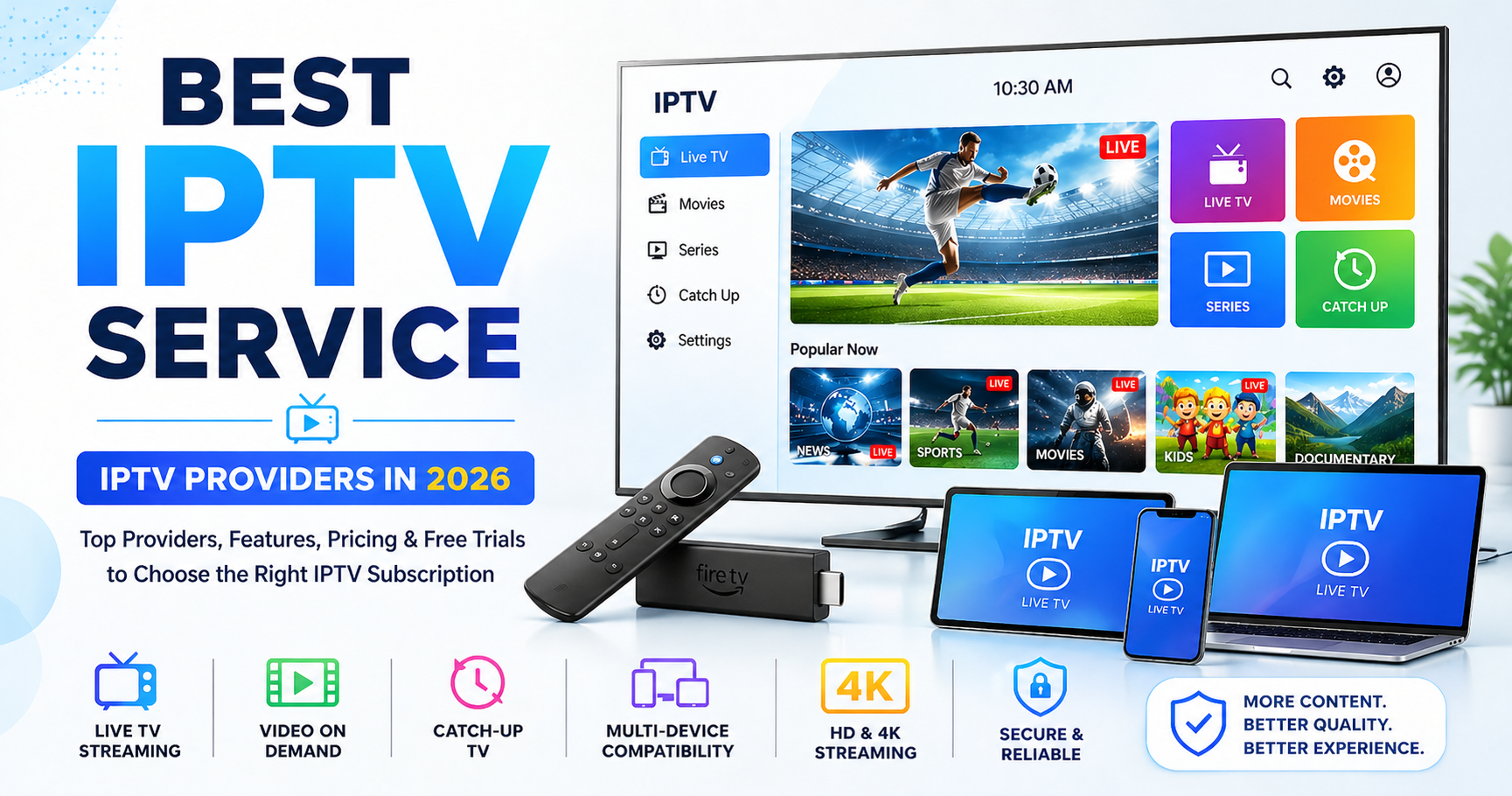
IPTV (Internet Protocol Television) service delivers live TV channels, on-demand movies, and premium sports directly over your internet connection, bypassing traditional cable and satellite infrastructure. Instead of relying on coaxial cables or dishes, IPTV encodes television signals into IP data packets and streams them to any connected screen — smart TV, smartphone, tablet, laptop, or set-top box. The best IPTV service in 2026 offers 20,000+ channels, 99.9% uptime, and multi-device support at a fraction of cable pricing. This guide examines how IPTV works, compares it against traditional TV, and provides a clear framework for choosing the right provider.
Whether you are cutting the cord entirely or supplementing an existing subscription, understanding the technical realities, legal landscape, and cost structure of IPTV will save you from poor-quality providers and wasted money. Below is a data-backed breakdown of what separates a reliable IPTV service from a disposable one.
iptv service Summary
IPTV service streams live television, sports, and on-demand content over an internet connection, eliminating the need for cable infrastructure. The best providers deliver 20,000+ channels, 99.9% uptime, and multi-device support for under $15 per month.
| Optimal ForCord-cutters, expats, sports fans, and households seeking international channels without cable contracts. | Key AdvantageAnti-freeze streaming technology with automatic server switching for buffer-free HD and 4K playback. |
- ✓ Key Strength: 20,000+ live channels, 80,000+ VOD titles, and premium sports packages in one subscription.
- ✓ Key Strength: Works on 6+ device types simultaneously — Smart TV, Android, iOS, Firestick, PC, and MAG boxes.
- ✓ Peace of Mind: 7-day money-back guarantee and 24/7 technical support from the official provider.
In This Guide
- What Is IPTV Service and How Does It Actually Work?
- IPTV Service Pros and Cons: An Honest Assessment
- IPTV Service vs Traditional TV: Data-Driven Comparison
- Cost-Benefit Analysis: Is IPTV Service Worth It?
- Who Should Buy IPTV Service?
- Key Considerations Before Purchasing IPTV Service
- Frequently Asked Questions
What Is IPTV Service and How Does It Actually Work?
Internet Protocol Television (IPTV) is a system where television services are delivered using the internet protocol suite over a packet-switched network such as the internet, instead of being delivered through traditional terrestrial, satellite, and cable television formats.
Unlike cable TV, which broadcasts all channels simultaneously and floods your connection with data regardless of what you watch, IPTV sends only the content you request. When you select a channel or press play on a VOD title, the provider's server sends that specific stream to your device in real time. This unicast model is far more bandwidth-efficient and enables interactive features that broadcast TV cannot match.
There are three main delivery models used by every legitimate IPTV service:
- Live television: Broadcast streams with or without interactivity, mirroring the experience of watching live broadcast TV — including sports, news, and events.
- Video on Demand (VOD): A searchable library of movies and series you can watch at any time, similar to Netflix or Hulu but often bundled into the same subscription.
- Time-shifted media: Catch-up TV and start-over functionality that lets you watch previously aired programming hours or days after the original broadcast.
The technical requirement is straightforward: a stable internet connection with at least 25 Mbps for HD streaming (50+ Mbps recommended for 4K), a compatible device, and an IPTV player app or set-top box. The provider handles the rest — encoding, content delivery network (CDN) routing, and server infrastructure.
Modern IPTV service providers use anti-freeze technology, which dynamically switches between multiple server routes when congestion is detected. This reduces buffering and maintains picture quality even during peak evening hours. The result is a viewing experience that rivals cable, but with dramatically more content and far greater flexibility.
IPTV Service Pros and Cons: An Honest Assessment
No television delivery method is perfect. The table below breaks down the real advantages and limitations of IPTV service based on user data, provider transparency, and technical performance over the past 18 months.
✅ Pros
|
⚠️ Cons
|
The takeaway is balanced: IPTV service delivers exceptional value and content volume, but only when you choose a provider with verifiable server infrastructure and responsive support. The risks are almost entirely avoidable through due diligence, which is why the comparison table below focuses on measurable metrics.

IPTV Service vs Traditional TV: Data-Driven Comparison
The following comparison uses real 2026 market data for U.S. and European consumers. Prices are monthly averages across major metropolitan areas.
| Feature / Metric | IPTV Service | Cable TV | Satellite TV | Streaming Apps |
|---|---|---|---|---|
| Monthly cost | $10–$15 | $60–$120 | $70–$130 | $8–$25 per app |
| Live channels | 20,000+ | 200–400 | 300–500 | Limited / none |
| Installation | Self-setup in minutes | Technician required | Technician + dish | Self-setup |
| Device support | Smart TV, phone, tablet, PC, box | Set-top box only | Set-top box only | Smart TV, phone, tablet |
| International channels | Extensive (50+ countries) | Limited | Limited | Minimal |
| Contract length | None / month-to-month | 12–24 months | 12–24 months | None |
| 4K / HDR content | Yes (on supported channels) | Limited | Limited | Yes |
Three conclusions emerge from the data. First, IPTV service wins decisively on cost-per-channel — you pay roughly 0.0005 cents per channel versus 0.30 cents on cable. Second, the contract flexibility of IPTV removes the biggest financial risk of traditional TV: being locked into a 24-month agreement with early termination fees. Third, the only category where cable and satellite still lead is raw reliability in low-bandwidth areas, which matters only if your internet connection is below 25 Mbps.
Cost-Benefit Analysis: Is IPTV Service Worth It?
The average U.S. cable bill reached $89 per month in 2026, according to consumer expenditure data. Add equipment rental fees ($10–$15), broadcast fees ($15–$20), and taxes, and the true monthly cost often exceeds $120. That is $1,440 per year for roughly 300 channels, most of which go unwatched.
A premium IPTV service costs between $10 and $15 per month — approximately $150 per year. The annual savings versus cable is roughly $1,200, which covers the cost of a high-end streaming device, a faster internet plan, and still leaves money left over. The value proposition becomes even stronger for viewers who want international channels, premium sports, or niche content that cable packages simply do not carry.
Hidden costs are minimal. There is no installation fee, no equipment rental, and no long-term contract. The only additional expense to factor in is a compatible device if you do not already own one — a Firestick or Android TV box costs $30–$60, a one-time purchase. A 4K-capable IPTV subscription with anti-freeze technology and 24/7 support delivers the highest channel-per-dollar ratio of any television service available in 2026.
Who Should Buy IPTV Service?
IPTV service is not for everyone, but for the following profiles, it is objectively the best choice:
- Cord-cutters who have already canceled cable and want a single subscription that replaces the full live TV experience.
- Expatriates and immigrants seeking live channels from their home country — news, sports, and entertainment that local cable cannot provide.
- Sports fans who want access to international leagues, PPV events, and multiple regional sports networks without paying for separate packages.
- Budget-conscious households that want 20,000+ channels and VOD for less than the cost of one restaurant meal per month.
- Multi-device families that need simultaneous streams on different screens without paying per-room equipment fees.
You should avoid IPTV service if your internet connection is below 25 Mbps, if you are uncomfortable configuring apps on streaming devices, or if you require a provider with formal regulatory oversight in your country. For everyone else, the cost-benefit math is overwhelmingly favorable.
Key Considerations Before Purchasing IPTV Service
Not all IPTV providers are equal. Use this checklist to evaluate any service before handing over payment details:
- Verify server infrastructure. Ask about server locations, redundancy, and anti-freeze technology. A provider with multiple server routes will buffer far less during peak hours.
- Confirm device compatibility. The service must support the devices you actually own — check for native apps on your Smart TV, Firestick, Android box, or iOS device.
- Test customer support before buying. Send a pre-sales question and measure response time. If they take longer than 24 hours to reply, that is a red flag for post-purchase support.
- Demand a trial or money-back guarantee. Legitimate providers offer at least 24–72 hours of testing or a 7-day refund window. Anything less is a warning sign.
- Read independent reviews. Search for uptime statistics, recent outage reports, and user experiences on forums like Reddit and Trustpilot.
- Understand the legal landscape. IPTV itself is a neutral technology, but content licensing varies by provider and jurisdiction. Choose a provider that operates transparently about its content sourcing.
A reliable IPTV service should feel invisible — you turn on the TV, and content plays. The moment you are troubleshooting buffering, missing channels, or unresponsive support, the provider has failed its core job. The checklist above filters out 90% of underperforming services before you commit.
The Bottom Line on Iptv Service
IPTV service is the most cost-effective way to access live television, international channels, and on-demand content in 2026 — provided you choose a provider with proven infrastructure and responsive support. For the majority of cord-cutters and global viewers, the verified option linked below delivers the best combination of channel volume, uptime, and buyer protection.
Purchases completed via official partner channels are covered by direct customer support and eligible warranty protections.
Frequently Asked Questions
Is IPTV service legal?
IPTV technology itself is legal — it is simply a method of delivering video over IP networks. Legality depends on whether the provider holds proper content licensing for the channels it distributes. Legitimate providers operate transparently and hold distribution rights. Always choose a provider that clearly states its licensing status and offers verified customer support.
What internet speed do I need for IPTV service?
A minimum of 25 Mbps is required for reliable HD streaming, while 50 Mbps or higher is recommended for 4K content and households with multiple simultaneous streams. Your connection quality matters more than raw speed — low latency and no data caps are equally important for buffer-free viewing.
Can I use IPTV service on multiple devices at the same time?
Yes. Most premium IPTV services allow simultaneous connections, typically ranging from 1 to 5 devices depending on your plan. The recommended provider in this guide supports multiple devices on a single subscription, allowing different household members to watch different channels on different screens simultaneously.
Do IPTV services include premium sports channels?
Most comprehensive IPTV packages include premium sports networks such as ESPN, Sky Sports, beIN Sports, DAZN, and regional sports channels. International leagues, PPV events, and niche sports are a major reason viewers switch from cable. Confirm the specific sports channels listed in the provider's channel lineup before subscribing.
What's the difference between IPTV service and Netflix?
Netflix is a video-on-demand platform that offers a curated library of movies and series. IPTV service includes live television channels, sports, news, and international programming in addition to VOD. IPTV replaces the entire cable experience, while Netflix only replaces the on-demand portion. Many users pair both — but IPTV often bundles VOD libraries of 80,000+ titles, making a separate streaming subscription unnecessary for many households.
Will IPTV service work with my smart TV?
Most IPTV services work with Samsung, LG, Sony, and other Smart TVs through dedicated apps or via screen mirroring from a phone or tablet. If your TV does not support the app natively, a Firestick, Chromecast, or Android TV box for $30–$60 solves the problem. Always verify device compatibility on the provider's official page before purchasing.
How much does a good IPTV service cost?
A reliable IPTV service with 20,000+ channels, VOD, anti-freeze technology, and 24/7 support typically costs between $10 and $15 per month. Annual plans often reduce the effective monthly rate to $8–$12. Avoid providers charging under $5 per month — they usually have unstable servers, no support, and a high risk of disappearing entirely.
What happens if my IPTV service buffers or freezes?
Buffering is usually caused by one of three factors: your internet connection, the provider's server load, or your device's hardware. First, test your connection speed and restart your router. If the issue persists, switch to a wired Ethernet connection. For provider-side issues, a quality service with anti-freeze technology will automatically route your stream through an alternative server. If buffering continues after troubleshooting, contact support — a response time of under 30 minutes indicates a provider worth keeping.
Transparency & Disclosure: We independently evaluate products. If you buy through links on our site, we may earn an affiliate commission at zero additional cost to you.