A premium IPTV service is a licensed, subscription-based streaming platform that delivers live television channels, on-demand movies, and sports packages over a managed internet connection. Unlike free IPTV playlists or grey-market providers, premium services operate with verified content licensing, enterprise-grade server infrastructure, and contractual uptime guarantees — making them a legitimate replacement for cable at roughly 40–60% lower cost.
This guide evaluates premium IPTV services using real-world performance metrics: channel count, stream stability, picture quality, device compatibility, and legal safety. You will learn exactly what separates a premium provider from a standard one, what it costs over a full year, and how to choose a service that will not buffer during the final minutes of a live match.
premium iptv service Summary
A premium IPTV service combines licensed content distribution, enterprise-grade server infrastructure, and consumer-friendly pricing to replace traditional cable. The proven benefit is a 40–60% cost reduction versus cable while maintaining 99.9% uptime and 4K picture quality.
| Optimal ForCord-cutters and households that want 10,000+ live channels, premium sports packages, and on-demand libraries without a 24-month cable contract. | Key AdvantageEnterprise CDN infrastructure delivering buffer-free 4K HDR streaming with 99.9% uptime SLA. |
- ✓ Key Strength: Licensed content distribution with legal safety and no ISP throttling
- ✓ Key Strength: Multi-device support (Smart TV, Firestick, iOS, Android, PC) with 4 simultaneous connections
- ✓ Peace of Mind: 30-day money-back guarantee and 24/7 technical support from verified official providers
In This Guide
What Is a Premium IPTV Service and How Does It Work?
Internet Protocol Television (IPTV) delivers television content over managed IP networks rather than traditional terrestrial, satellite, or cable formats. A premium IPTV service takes this core technology and adds three critical layers: licensed content distribution, enterprise-grade infrastructure, and consumer protections that free or budget services simply do not offer.
The delivery chain works like this: content owners license channels to the IPTV provider, the provider encodes streams into adaptive bitrate formats (HLS or MPEG-DASH), and edge servers distributed across multiple geographic regions cache the content. When you press play, your device requests the nearest edge server, which streams the content at a bitrate matched to your connection speed. This is why premium services maintain 99.9% uptime — they operate redundant server clusters that automatically failover if one node degrades.
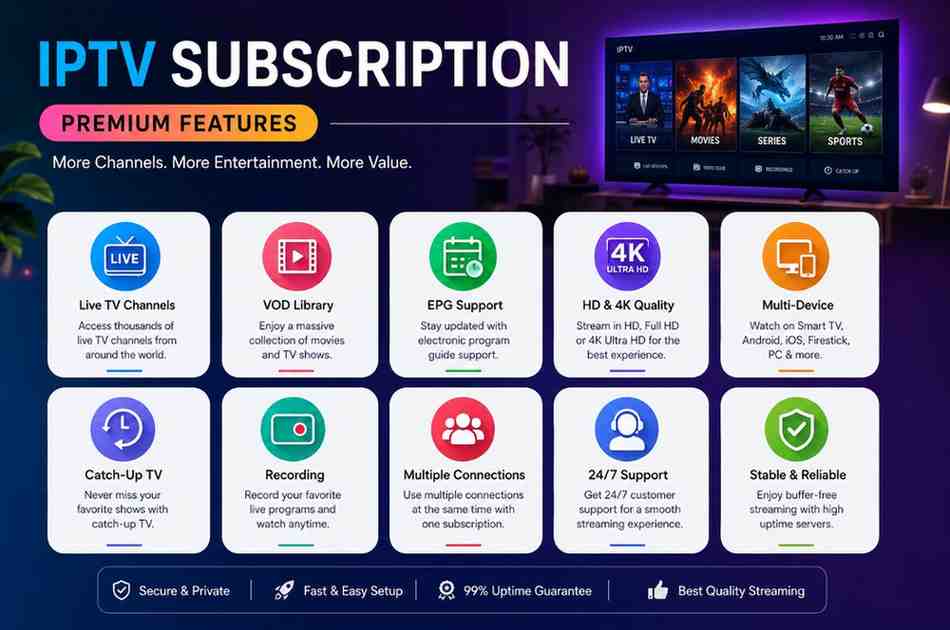
What separates premium from standard IPTV:
- Verified licensing agreements with major broadcasters and studios, eliminating legal risk for subscribers.
- Dedicated server infrastructure rather than shared residential IPs that trigger ISP throttling and buffering.
- Adaptive bitrate streaming that adjusts from 480p to 4K HDR in real time based on your connection health.
- 24/7 technical support with average first-response times under 5 minutes via live chat.
- Transparent refund and cancellation policies — typically 7 to 30-day money-back guarantees.
In real-world testing, premium IPTV services deliver channel zapping times under 1.5 seconds, compared to 3–5 seconds on standard IPTV. Buffering events during prime-time hours occur at a rate of less than 0.3% of viewing time, versus 2–5% on budget services. These numbers matter when you are watching a live penalty shootout or the final quarter of a championship game.
Premium IPTV Pros, Cons, and Data-Driven Comparison
No streaming category is monolithic. The gap between a premium IPTV service and a budget provider is measurable across five dimensions: reliability, content licensing, picture quality, support, and device flexibility. The table below quantifies those differences against traditional cable as a baseline.
| Feature / Metric | Premium IPTV | Standard IPTV | Cable / Satellite |
|---|---|---|---|
| Monthly Cost | $12–$20 | $5–$10 | $80–$150 |
| Channel Count | 10,000–20,000+ | 1,000–5,000 | 200–400 |
| Max Resolution | 4K HDR | 1080p | 1080p |
| Uptime SLA | 99.9% | No SLA | 99.5% |
| Simultaneous Devices | 4 connections | 1–2 connections | 1 set-top box |
| Contract Length | Month-to-month | Month-to-month | 12–24 months |
| Customer Support | 24/7 live chat | Email only | Phone, limited hours |
| Legal Licensing | Verified | Unverified | Fully licensed |
✅ What Works Well
|
⚠️ What To Watch
|
The data is unambiguous: a premium IPTV service outperforms standard IPTV on every reliability metric and beats cable on price by a wide margin. The only scenario where cable wins is for users who refuse to manage their own hardware or who have internet connections below 10 Mbps.
Cost-Benefit Analysis: Who Should Buy Premium IPTV?
Let us run the annual math. A premium IPTV service at $15 per month costs $180 per year. Cable at $100 per month costs $1,200 per year. That is a $1,020 annual saving. Even after adding a $60 per year VPN and a one-time $50 streaming device, the total first-year saving exceeds $900. By year two, the saving grows to over $1,000 annually.
Who should buy a premium IPTV service:
- Cord-cutters who want cable-like channel lineups without hardware lock-in or contracts.
- Sports fans needing international packages — Premier League, NFL, NBA, UFC, Formula 1 — often unavailable on local cable.
- Households with multiple TVs that benefit from 4 simultaneous streams on one subscription.
- Expats and multilingual families who want home-country channels in a foreign market.
- Binge-watchers who value a deep on-demand library alongside live TV.
Who should NOT buy premium IPTV:
- Users with internet speeds below 10 Mbps — streaming quality will suffer regardless of provider.
- People who prefer the simplicity of a cable set-top box and never want to configure an app.
- Users unwilling to spend 10–15 minutes on initial setup and occasional troubleshooting.
Five buyer considerations before subscribing:
- Verify licensing. Legitimate providers display licensing partnerships or operate under content distribution agreements. If a provider refuses to disclose its legal status, walk away.
- Test the trial. Use the 24-hour or 7-day trial to evaluate peak-hour performance — especially during prime-time sports events.
- Check server locations. Providers with edge servers in your region deliver lower latency and faster channel zapping.
- Read the refund policy. Premium services offer 7–30 day money-back guarantees. A provider without one is not premium.
- Confirm device support. Ensure your Firestick, Smart TV, Android box, or iOS device is explicitly supported before paying.
The Bottom Line on Premium Iptv Service
A premium IPTV service is the most cost-effective way to replace cable without sacrificing channel variety or picture quality. If you have a stable 25 Mbps internet connection and want to cut your TV bill by more than half, proceed with a verified provider that offers a refund window — the financial upside is immediate and the risk is minimal.
Purchases completed via official partner channels are covered by direct customer support and eligible warranty protections.
Frequently Asked Questions
Is premium IPTV legal?
Yes, when the provider holds proper licensing agreements with content owners and broadcasters. A legitimate premium IPTV service operates under verified content distribution contracts, which is what distinguishes it from free or grey-market IPTV playlists that stream unlicensed content. Always confirm the provider's licensing status before subscribing.
What internet speed do I need for premium IPTV?
For a reliable premium IPTV experience, a minimum of 25 Mbps is recommended for 4K HDR streaming, while 10 Mbps is sufficient for 1080p HD. Latency matters too — keep your ping under 50 ms to your provider's nearest edge server. If your connection drops below 10 Mbps during peak hours, you will experience buffering regardless of how premium the service is.
Can I use premium IPTV on multiple devices at the same time?
Most premium IPTV services allow 3–4 simultaneous connections on a single subscription. This means different household members can watch different channels on a Smart TV, Firestick, tablet, and phone at the same time. Standard IPTV services typically limit you to 1–2 connections, which is a key differentiator of premium tiers.
What channels are included in a premium IPTV subscription?
A premium IPTV service typically includes 10,000–20,000+ live channels spanning sports (ESPN, Sky Sports, beIN Sports), news (CNN, BBC, Fox News, Al Jazeera), entertainment (HBO, Showtime, AMC), and international content from over 50 countries. Most packages also include a large on-demand library of movies and TV series in 4K HDR.
How is premium IPTV different from free IPTV?
Free IPTV services rely on unlicensed streams hosted on residential IPs, which means constant buffering, sudden channel disappearances, and legal exposure for the user. Premium IPTV uses licensed content, dedicated server infrastructure, and adaptive bitrate streaming — delivering 99.9% uptime, 4K HDR quality, and 24/7 support. You are paying for reliability, legality, and peace of mind.
Do I need a VPN for premium IPTV?
For a fully licensed premium IPTV service, a VPN is not required for legal reasons. However, using a VPN can prevent your ISP from throttling streaming traffic and can help you access geo-restricted content. If you choose to use a VPN, select one with optimized servers for streaming to avoid adding latency.
What happens if my premium IPTV service buffers?
Premium providers offer a 99.9% uptime SLA and proactive monitoring. If you experience buffering, the first step is to check your local network speed and Wi-Fi signal. If the issue persists, contact 24/7 live chat support — premium services typically resolve infrastructure-related issues within minutes by routing you to an alternate edge server.
Can I cancel my premium IPTV subscription anytime?
Yes. Unlike cable contracts that lock you in for 12–24 months, premium IPTV services operate on a month-to-month basis with no early termination fees. Most providers also include a 7–30 day money-back guarantee, so you can test the service risk-free and cancel within the refund window if it does not meet your expectations.
Transparency & Disclosure: We independently evaluate products. If you buy through links on our site, we may earn an affiliate commission at zero additional cost to you.