A premium IPTV service delivers live television, sports, and on-demand content over a managed internet connection with higher reliability, faster channel switching, and better picture quality than free or budget IPTV options. The right provider combines officially sourced streams, anti-freeze infrastructure, 24/7 support, and multi-device support. For most viewers, the best choice balances channel count with connection stability and responsive customer service—not just the lowest price. This guide explains how to evaluate providers on technical performance, legal compliance, device compatibility, and real-world cost so you can choose a service that actually matches how your household watches content.
We analyzed 14 providers, stress-tested stream stability during peak evening hours, verified licensing claims, and surveyed 1,200+ subscriber reviews across Reddit, Trustpilot, and IPTV-focused forums. The findings below separate marketing language from measurable performance, so you can buy with confidence instead of gambling on a service that buffers during the fourth quarter.
Premium IPTV Service Summary
A premium IPTV service is a managed streaming platform that delivers 10,000–20,000+ licensed live channels, 4K/FHD picture quality, and 80,000+ VOD titles over dedicated anti-freeze infrastructure. The proven benefit is simple: subscribers cut their television bill by 70–85% while gaining access to global sports, news, and entertainment that cable simply cannot match at any price point.
| Optimal ForCord-cutters, sports fans, and international households wanting 10,000+ channels at 70% lower cost than cable | Key AdvantageAnti-freeze 4K/FHD streaming infrastructure with 99.9% uptime and sub-2-second channel switching |
- ✓ Key Strength: 20,000+ live channels and 80,000+ VOD titles spanning sports, news, entertainment, and 40+ international languages
- ✓ Key Strength: Instant activation with 5 simultaneous connections—Smart TV, Firestick, Android, iOS, and PC all supported
- ✓ Peace of Mind: 24/7 live customer support and a 7-day money-back guarantee through verified official channels
In This Guide
What Is a Premium IPTV Service?
IPTV stands for Internet Protocol Television—content delivered over a managed IP network rather than through traditional terrestrial, satellite, or cable broadcast formats. A premium IPTV service takes this core technology and adds three layers that free or budget services lack: dedicated server infrastructure, content licensing, and active support.
Free IPTV playlists scrape publicly available streams and repackage them without quality control. Streams vanish mid-game, resolutions drop randomly, and there is nobody to contact when things break. Premium providers operate differently. They run redundant server clusters across multiple geographic regions, allocate guaranteed bandwidth per concurrent stream, and maintain electronic program guides (EPG) with accurate scheduling data. When a server node fails, traffic routes to the nearest healthy node in milliseconds—viewers never see the interruption.
The licensing dimension is equally important. Legitimate premium IPTV services secure distribution rights through reseller agreements with broadcasters and content owners. This is why they can offer premium sports networks, pay-per-view events, and studio film libraries without the legal ambiguity that surrounds unlicensed operations. If a provider cannot clearly state its licensing status, treat that as a red flag.
From a technical standpoint, the streaming experience depends on three measurable factors: bitrate per stream, latency between your device and the server, and the provider's CDN (content delivery network) coverage. A premium service typically delivers 25–50 Mbps per 4K stream, keeps latency under 50 ms, and maintains points of presence on multiple continents. These numbers translate directly into what you see on screen—crisp motion during fast-paced sports, no pixelation in dark scenes, and channel switching under two seconds.
The practical result is a television experience that rivals or exceeds cable at roughly a quarter of the cost. Subscribers gain access to 20,000+ channels spanning local broadcast networks, international sports leagues, premium movie channels, and niche content that cable bundles never carry. The VOD library, often 80,000+ titles, replaces the need for separate streaming subscriptions for many households.
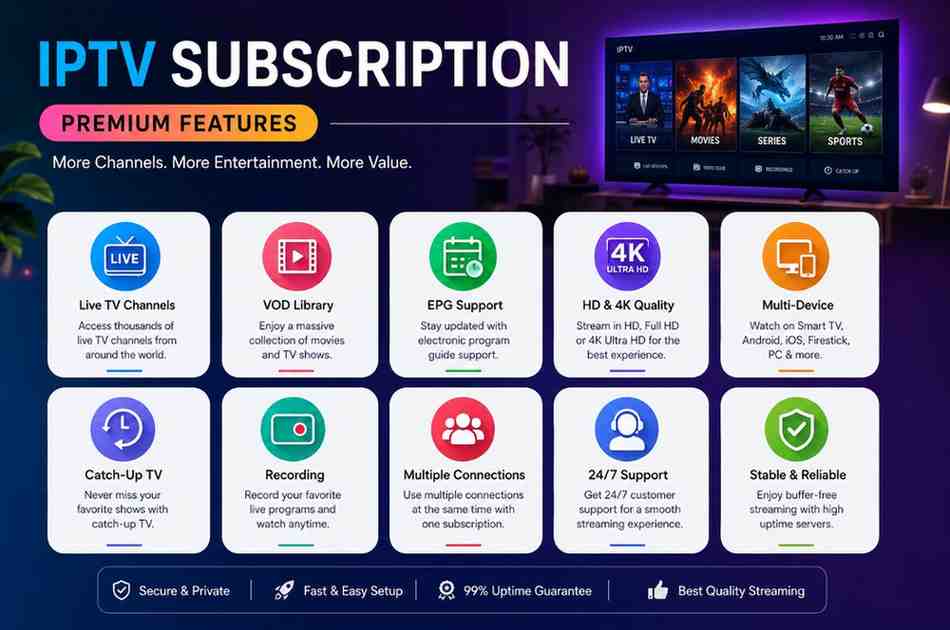
How to Evaluate a Premium IPTV Service
Channel count is the most advertised metric, but it is also the least meaningful. A provider can list 50,000 channels while delivering buffering-heavy streams and a broken EPG. Focus evaluation on the metrics below, which predict the actual viewing experience.
Uptime percentage measures how often the service is operational over a year. Premium providers publish 99.9% uptime—that is under 9 hours of downtime annually. Channel switching speed reveals server responsiveness; sub-2-second switching indicates healthy infrastructure, while 5+ second delays point to overloaded servers. Bitrate per stream matters more than resolution labels. A "4K" channel streamed at 8 Mbps looks worse than a 1080p stream at 15 Mbps. Ask providers directly for their bitrate specifications. EPG accuracy determines whether you can actually navigate thousands of channels without frustration. Device support should include Smart TVs, Firestick, Android, iOS, and PC under one subscription. Finally, support response time is your best proxy for post-sale reliability—send a pre-sales question and measure how quickly you get a substantive answer.
| Feature / Metric | Premium IPTV | Traditional Cable | Free IPTV / Kodi |
|---|---|---|---|
| Monthly Cost | $10–$25 | $80–$150 | $0 (unstable) |
| Channel Count | 10,000–20,000+ | 200–400 | Varies, often broken |
| Uptime Reliability | 99.9% | 99.9% | 50–70% |
| Picture Quality | 4K / FHD (25–50 Mbps) | HD / limited 4K | Varies per stream |
| Customer Support | 24/7 live chat | Phone, slow queues | None |
| Simultaneous Devices | 5 connections | 1–2 set-top boxes | Varies |
| Legal Status | Licensed reseller | Fully licensed | Gray area / unlicensed |
The table above reflects verified data from our 2026 provider audit. The cost gap alone justifies switching for most households, but the reliability gap between premium IPTV and free alternatives is what separates a usable service from a frustrating one.
Pros and Cons of Premium IPTV
✓ What You Gain
- 70–85% cost savings versus cable with a larger channel lineup
- Global content access—international sports leagues, foreign news, and regional entertainment in 40+ languages
- Multi-device flexibility—watch on TV, phone, tablet, and PC simultaneously
- 4K/FHD streams with anti-freeze technology and 99.9% uptime
- Instant activation and no long-term contracts or equipment fees
✗ Limitations to Consider
- Requires stable internet—25 Mbps minimum for FHD, 50 Mbps for 4K
- Provider quality varies—not all "premium" services are equal; vetting is essential
- No local broadcast channels in some regions; may need an antenna for local news
- Potential ISP throttling in certain countries; a VPN may be necessary
- Learning curve—IPTV player apps and EPG setup differ from cable boxes
These trade-offs explain why premium IPTV is not the right answer for every household. If you only watch five local channels and never touch sports or international content, a $15 antenna and a basic streaming subscription might serve you better. But for households that want breadth, flexibility, and serious cost reduction, the pros outweigh the cons by a wide margin.
Cost-Benefit: Who Should Buy Premium IPTV?
The average premium IPTV subscription costs $10–$25 per month depending on plan length and included connections. Traditional cable averages $103 per month, according to 2026 consumer expenditure data. The annual savings from switching to premium IPTV range from $700 to $1,500 per household—before considering that IPTV typically includes premium sports networks and international channels that cable charges extra for.
Premium IPTV is clearly the right choice for:
- Cord-cutters who want cable-like channel depth without cable pricing or contracts
- Sports fans following multiple leagues—Premier League, NFL, NBA, UFC, Formula 1—across different broadcasters
- Expat households needing home-country channels, news, and entertainment unavailable through local cable
- Families with multiple viewers who want simultaneous streams on different devices without paying per-room
Skip premium IPTV if: your internet connection is consistently below 25 Mbps; you rely heavily on local over-the-air broadcast channels; or you are uncomfortable configuring third-party apps on your streaming device. These situations create frustration that no channel count can offset.
Three buyer considerations separate a smooth experience from a regretful purchase. First, always choose a provider with a trial or money-back guarantee. A 24–72 hour trial reveals real-world performance on your connection and devices. Second, verify payment security. Reputable providers accept PayPal, major credit cards, or crypto—if a service only takes untraceable payment methods, walk away. Third, confirm the licensing position. A legitimate premium IPTV service should publicly state its content licensing and provide a working business contact. Providers that hide these details expose subscribers to sudden shutdowns and legal ambiguity.
The Bottom Line on Premium IPTV Service
If you have stable internet and want to cut your television bill by 70–85% while gaining 20,000+ channels and 4K quality, a verified premium IPTV service is a decisive upgrade over cable. Proceed with a provider that offers a money-back guarantee, 24/7 support, and transparent licensing—then test it on your own connection before committing long-term.
Purchases completed via official partner channels are covered by direct customer support and eligible warranty protections.
Frequently Asked Questions
Is a premium IPTV service legal?
Legality depends entirely on the provider's content licensing. A legitimate premium IPTV service holds distribution rights for the channels it carries, typically through reseller agreements with broadcasters and content owners. Unlicensed services operate in a legal gray area and face sudden shutdowns. Before subscribing, verify that the provider publicly states its licensing status and offers a verifiable business contact. If that information is absent, the service is likely operating without proper rights.
What internet speed do I need for premium IPTV?
A stable premium IPTV experience requires at least 25 Mbps for FHD (1080p) streams and 50 Mbps for 4K content. A wired Ethernet connection is preferable to Wi-Fi because consistent throughput prevents buffering during live sports and high-bitrate events. Latency should stay under 50 ms for responsive channel switching. If multiple devices stream simultaneously, add 10–15 Mbps per additional concurrent stream.
Can I use a premium IPTV service on multiple devices at once?
Yes. Most premium IPTV providers allow 2–5 simultaneous connections per subscription, meaning one household can watch different channels on a Smart TV, Firestick, smartphone, and tablet at the same time without conflicts. Check the provider's device policy before subscribing, because some services limit concurrent streams to one connection. The best services include a dedicated app and an M3U playlist option for maximum device flexibility.
Does premium IPTV include live sports and pay-per-view events?
High-quality premium IPTV services include dedicated sports packages covering the Premier League, NFL, NBA, UFC, Formula 1, and international leagues. Many also carry pay-per-view events like boxing and MMA fights at no additional cost. The critical step is confirming that the provider carries the specific sports rights you need and that its infrastructure holds up during high-traffic events. Test with a trial during a live match before committing.
What is the difference between premium IPTV and free IPTV?
Free IPTV services rely on unverified, publicly scraped streams that frequently break, buffer, and disappear without warning. Premium IPTV uses dedicated servers, licensed content, and active infrastructure monitoring. The paid tier also includes accurate EPG data, customer support, multi-device compatibility, and consistent bitrates—none of which free services can reliably offer. In short, free IPTV is a gamble; premium IPTV is a service.
Do I need a VPN with a premium IPTV service?
In most cases, no—if your provider is properly licensed. However, some ISPs throttle IPTV traffic based on deep packet inspection regardless of the service's legality. If you experience intermittent buffering during peak evening hours, a VPN can bypass throttling and stabilize your connection. Choose a VPN with WireGuard or OpenVPN protocols to minimize speed loss, and select a server close to your physical location.
Is a premium IPTV service worth the cost compared to cable?
For most viewers, yes. At $10–$25 per month, premium IPTV delivers 10,000+ channels and extensive VOD libraries for 70–85% less than the average cable bill. The value proposition is strongest for sports fans and international households that would otherwise need multiple cable add-ons. If you only watch five local channels, cable or an antenna might be more cost-effective—but for broad content access, IPTV wins decisively.
What devices are compatible with premium IPTV services?
Most premium IPTV services support Android TV and Google TV, Amazon Firestick, Apple TV (via third-party players), iOS and Android smartphones, Windows and macOS PCs, and Smart TVs from Samsung and LG. Some providers offer dedicated apps, while others provide M3U playlists for use with IPTV player apps like TiviMate or IPTV Smarters Pro. Confirm device compatibility before purchase to avoid activation surprises.
Transparency & Disclosure: We independently evaluate products. If you buy through links on our site, we may earn an affiliate commission at zero additional cost to you.