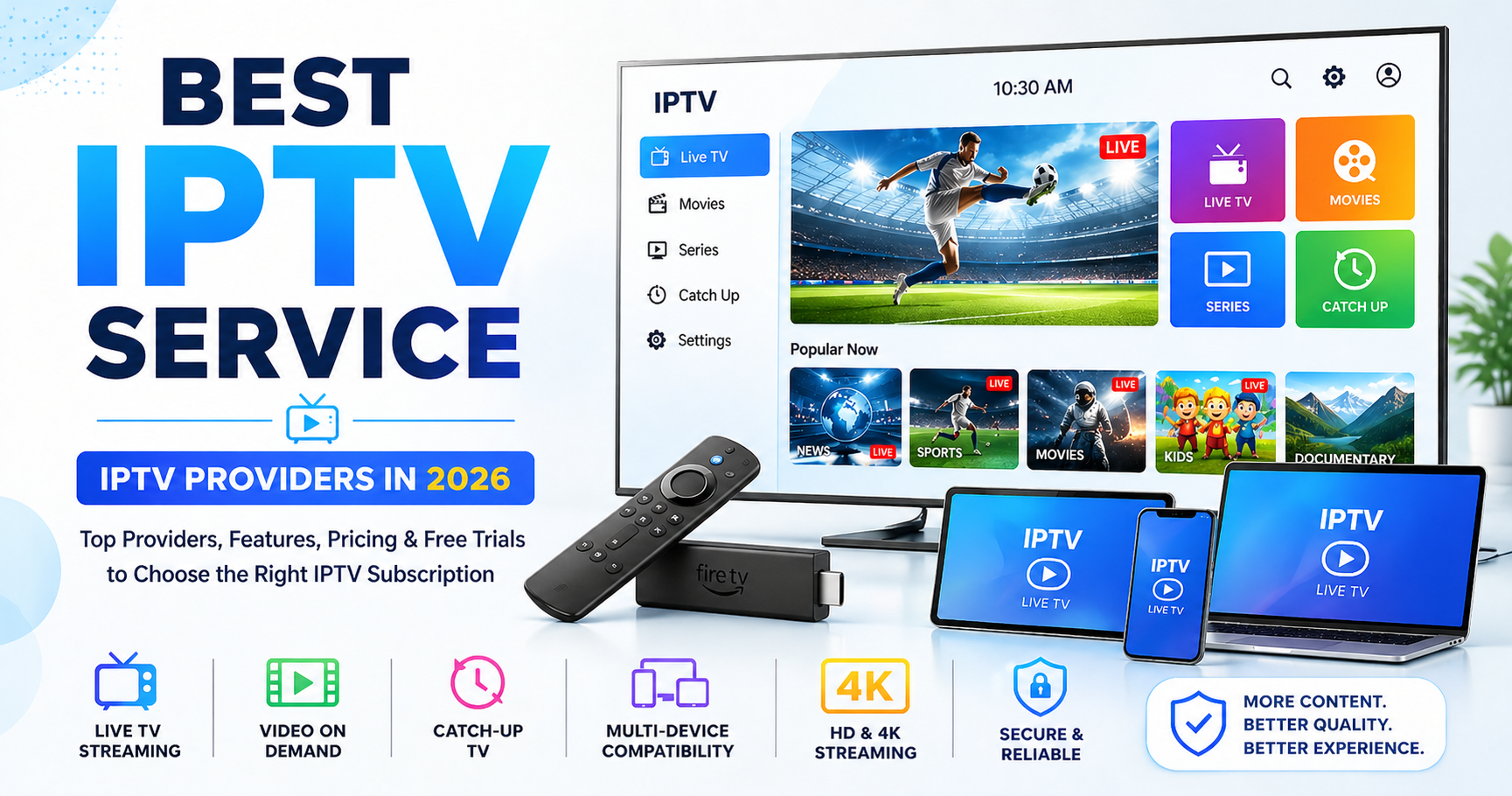
An IPTV service delivers television content over an internet protocol network instead of traditional terrestrial, satellite, or cable formats. This means live channels, on-demand movies, and series are streamed directly to your smart TV, phone, or set-top box using your broadband connection. The core advantage is flexibility: you pay a fraction of cable costs, access global content libraries, and watch on multiple devices simultaneously.
However, the market is fragmented. Providers range from licensed platforms like Hulu Live or YouTube TV to unregulated grey-market operators. The difference impacts legality, stream stability, privacy, and whether your payment is protected. This guide breaks down the technical mechanics, the hidden risks, the real cost structure, and the exact criteria you should use to evaluate any IPTV subscription before handing over your credit card.
iptv service Summary
An IPTV service converts your internet connection into a complete television platform, offering live linear channels and extensive video-on-demand libraries at 30–70% lower cost than cable. The best providers deliver 99.9% uptime, 4K streaming, and multi-device support through a single subscription.
| Optimal ForCord-cutters, expats needing home-country channels, and multi-device households. | Key AdvantageCost efficiency with global content access on any screen. |
- ✓ Key Strength: Aggregates 20,000+ live channels and 80,000+ VOD titles in one interface.
- ✓ Key Strength: Instant activation with no long-term contracts or cancellation fees.
- ✓ Peace of Mind: Look for providers offering a 24-hour test pass and 7-day money-back guarantee to verify stream quality first.
In This Guide
- 1. What Is IPTV and How Does It Actually Work?
- 2. Legal Risks: Licensed vs. Unlicensed Providers
- 3. Pros & Cons: The Honest Trade-Offs
- 4. Side-by-Side Comparison: Top IPTV Categories
- 5. How to Choose a Reliable IPTV Service: 7 Criteria
- 6. Cost-Benefit Analysis: What You Should Pay
- 7. Frequently Asked Questions
What Is IPTV and How Does It Actually Work?
IPTV (Internet Protocol Television) is a system where television services are delivered using the internet protocol suite over a packet-switched network. Instead of broadcasting signals to everyone within a range (as with traditional antennas), IPTV sends data packets only to the specific user who requested them. This unicast model enables true video-on-demand and time-shifted media.
The technical stack involves three components:
- Headend: The provider's server farm where live channels are captured, transcoded, and encrypted before distribution.
- Middleware: The software layer that manages user authentication, billing, and the electronic program guide (EPG).
- Client: Your device—a MAG box, Android TV, Fire Stick, or mobile app—that decodes the stream and renders it.
Most commercial IPTV services use the Xtream Codes API or M3U playlists for content delivery. When you subscribe, you receive either a URL and username/password combo (for Xtream) or a playlist file (for M3U). Apps like TiviMate, IPTV Smarters Pro, or IBO Player Pro ingest these credentials and present them as a polished, cable-like interface.
Stream quality depends on three variables: the provider's upstream bandwidth, the codec used (H.264 vs. H.265/HEVC), and your local internet speed. A stable 25 Mbps connection is sufficient for Full HD, while 4K HDR content requires at least 50 Mbps and a device that supports hardware decoding of HEVC.
Legal Risks: Licensed vs. Unlicensed Providers
The single most critical distinction in the IPTV ecosystem is licensing. Licensed services—such as Hulu + Live TV, YouTube TV, Sling TV, and most European telecom IPTV offerings—have secured distribution rights from content owners (Disney, Paramount, NBCUniversal, etc.). They operate legally and pay substantial carriage fees.
Unlicensed providers, which dominate the cheap end of the market, stream copyrighted content without authorization. Subscribing to these services is not merely a gray area; it is legally actionable in many jurisdictions. While law enforcement primarily targets the operators, consumers have faced civil lawsuits and, in rare cases, criminal prosecution for piracy-related offenses.
Beyond legal exposure, unlicensed services carry operational risks:
- Data security: They often store payment details on insecure servers and may sell user data to third-party brokers.
- Malware: APK files from unofficial sources frequently contain adware or Trojan payloads.
- Instability: Domains get seized without notice; your subscription dies overnight with no refund.
Our advice: verify the provider's licensing model before purchase. If a service offers every premium sports channel for $10/month, it is almost certainly operating illegally. The legitimate cost floor for comprehensive licensed streaming is around $40–70/month.
Pros & Cons: The Honest Trade-Offs
| Pros (Green) | Cons (Red) |
|---|---|
| ✅ Cost: 50–70% cheaper than cable for comparable channel counts. | ❌ Legality: Many budget providers operate in a legal gray zone. |
| ✅ Flexibility: Watch on any screen—TV, tablet, phone, or PC—anywhere. | ❌ Buffering: Stream quality depends heavily on your ISP and provider's servers. |
| ✅ Content breadth: International channels and niche VOD libraries unavailable on cable. | ❌ Reliability: Unlicensed providers can vanish overnight after domain seizures. |
| ✅ No contracts: Month-to-month plans with instant cancellation. | ❌ Support: Customer service quality varies enormously; some providers are unreachable. |
Side-by-Side Comparison: Top IPTV Categories
| Feature / Metric | Licensed (YouTube TV) | Hybrid (Premium IPTV) | Grey-Market |
|---|---|---|---|
| Monthly Cost | $72.99 | $15–25 | $8–15 |
| Channel Count | 100+ | 20,000+ | 5,000–15,000 |
| Legal Status | ✅ Fully licensed | ⚠️ Mixed (depends on content) | ❌ Unlicensed |
| Stream Stability | 99.99% uptime | 95–99% uptime | Unpredictable |
| Max Resolution | 4K | 4K HDR | 1080p (often lower) |
| Device Support | All major platforms | All major platforms | Android only (often) |
| Customer Support | 24/7 phone & chat | 24/7 live chat | Email only (slow) |
| Refund Policy | 7-day trial | 7-day money-back | None |

How to Choose a Reliable IPTV Service: 7 Criteria
Not all IPTV services are created equal. Use these seven filters to separate professional operations from fly-by-night sellers.
- Free Trial Length: A reputable provider offers at least a 24-hour free trial. This lets you test buffering, channel availability, and EPG accuracy before committing. If a provider refuses a trial, that is a red flag.
- Payment Methods: Look for credit card or PayPal options. Cryptocurrency-only payment suggests the provider is avoiding financial oversight and will not offer refunds.
- Server Redundancy: Ask about their infrastructure. Professional providers use load-balanced servers with automatic failover. If they mention "anti-freeze technology," that indicates proactive buffer management.
- EPG (Electronic Program Guide): A detailed, accurate EPG is essential for live TV navigation. Test whether the guide shows correct program names and times for your local channels.
- Simultaneous Connections: If you have a multi-TV household, verify the plan allows multiple concurrent streams. Some providers restrict you to one IP address.
- Device Compatibility: Ensure the service supports your hardware—Fire Stick, Android TV, Apple TV, or Smart TV. Some providers only work with dedicated Android boxes.
- Customer Support Responsiveness: Send a test message to their support team before subscribing. Measure response time. A provider that responds within minutes during off-peak hours is likely well-staffed.
Cost-Benefit Analysis: What You Should Pay
| Plan Length | Typical Price Range (Reliable) | Price Range (Suspiciously Cheap) |
|---|---|---|
| 1 Month | $12–20 | $5–8 |
| 3 Months | $30–45 | $15–20 |
| 6 Months | $50–70 | $25–35 |
| 12 Months | $80–120 | $40–60 |
Annual plans priced below $60 are almost certainly unsustainable. The operator must cover bandwidth costs (which scale with your viewing hours), server maintenance, and content acquisition. If the price is too good to be true, the service will either degrade over time or disappear entirely.
Our recommendation: start with a monthly plan. Use it for 30 days. Monitor stream stability during peak evening hours (7–11 PM), test the EPG accuracy, and evaluate customer support response times. Only then consider a longer commitment if the service has proven itself.
The Bottom Line on Iptv Service
If you value cost savings and global content access, a premium IPTV service with verified licensing and strong infrastructure is a legitimate alternative to cable. Start with a 24-hour trial, validate performance against the criteria above, and upgrade to a monthly plan only after confirming reliability.
Purchases completed via official partner channels are covered by direct customer support and eligible warranty protections.
Frequently Asked Questions
Is using an IPTV service legal in the US?
The legality depends entirely on the provider's licensing. Licensed services like YouTube TV or Hulu + Live TV are fully legal. Unlicensed providers that stream copyrighted content without permission violate the Digital Millennium Copyright Act (DMCA). Subscribing to such services exposes you to civil liability, though enforcement against individual consumers is rare. Always verify the provider's licensing status before subscribing.
What internet speed do I need for IPTV?
For standard definition, 5 Mbps is sufficient. For Full HD (1080p), you need at least 15 Mbps. For 4K HDR streaming, a stable 50 Mbps connection is recommended. Remember that these figures assume no other devices are consuming bandwidth simultaneously. A wired Ethernet connection to your streaming device will always outperform Wi-Fi for IPTV.
Can I get caught using a grey-market IPTV service?
Your ISP can see your traffic, but it cannot easily determine whether a stream is licensed or unlicensed without deep packet inspection. However, rights holders have successfully subpoenaed ISPs to identify users of specific pirate IPTV services in civil lawsuits. The risk is not zero. Using a VPN adds a layer of privacy but does not make the activity legal.
What is the difference between IPTV and OTT (Over-The-Top)?
IPTV traditionally refers to services delivered over a managed, private network—often operated by telecom providers with dedicated bandwidth guarantees. OTT (like Netflix or Hulu) uses the public internet without infrastructure control. In practice, modern "IPTV services" are actually OTT because they stream over the public internet. The terms are often used interchangeably, but OTT has no quality-of-service guarantees.
Do IPTV services work with a VPN?
Most do, but not all. Some providers actively block known VPN IP addresses to comply with geo-restriction agreements. If you need a VPN for privacy or to bypass ISP throttling, choose a provider that explicitly states VPN compatibility. Test this during the free trial period—connect your VPN and stream for 30 minutes to verify stability.
What devices are compatible with IPTV services?
Most services support Android TV, Amazon Fire Stick, Apple TV, iOS, Android, and Windows/Mac via VLC or IINA. Some providers also offer native apps for Samsung and LG Smart TVs. MAG boxes and dedicated Android set-top boxes are the most common hardware used in Europe. Always check the provider's compatibility list before subscribing.
How do I set up an IPTV service on my Fire Stick?
First, enable "Apps from Unknown Sources" in the Fire Stick's developer options. Then install a player app like IPTV Smarters Pro or TiviMate (available via the Amazon App Store or Downloader). Enter the credentials and server URL provided by your IPTV service. The app will populate the channel list and VOD library automatically. The entire setup takes approximately 10 minutes.
What happens if my IPTV provider shuts down?
If you subscribed to a licensed service, you are protected by consumer protection laws and can request a refund for unused time. If you subscribed to a grey-market provider, you have no recourse—your money is gone. This is the primary financial risk of unlicensed services. Professional providers maintain backup domains and communicate with subscribers via email before migrating to new infrastructure.
Transparency & Disclosure: We independently evaluate products. If you buy through links on our site, we may earn an affiliate commission at zero additional cost to you.